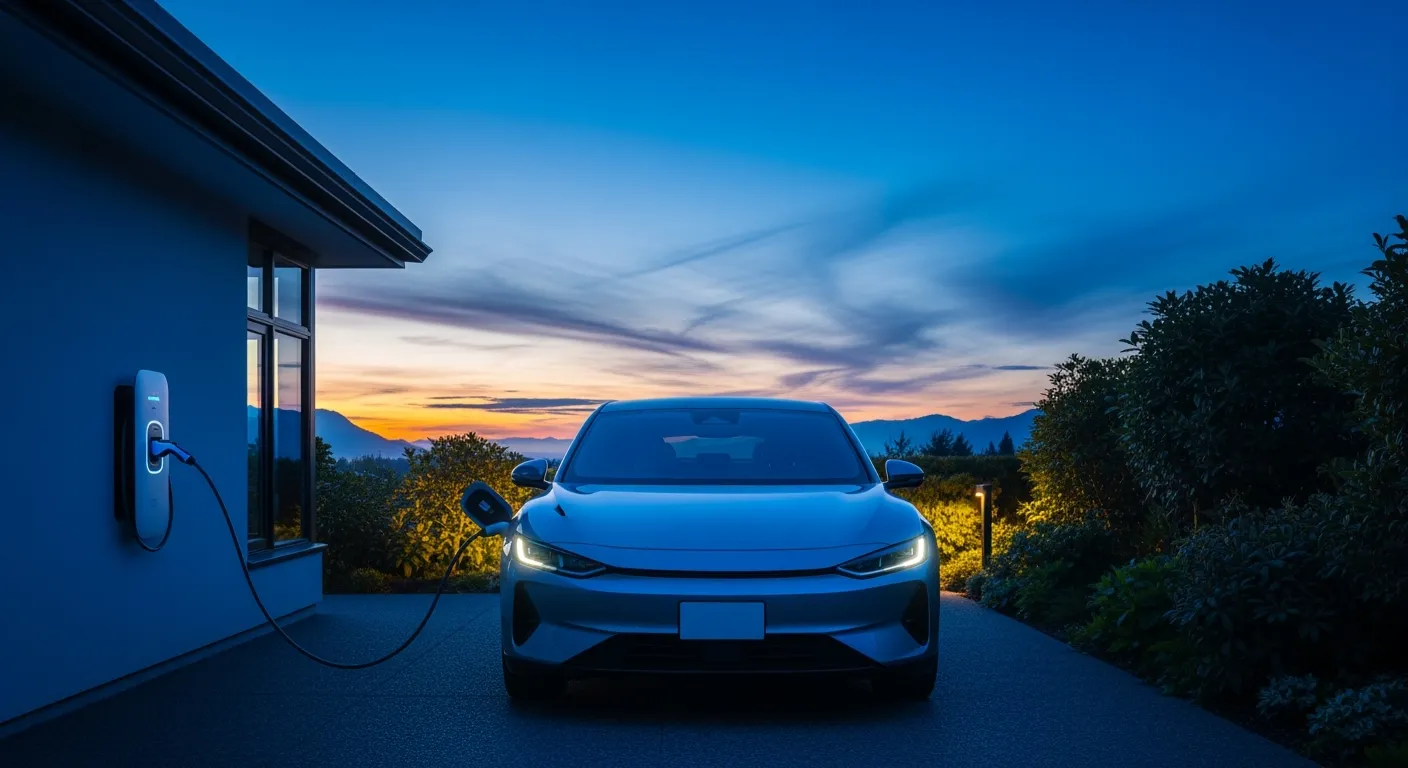
If you own an EV in British Columbia, 2026 is a good year to get serious about home charging.
That’s partly because the hardware is better than it used to be. Smart chargers are no longer a niche gadget for early adopters who enjoy fiddling with apps. They’re practical. They can schedule charging, track energy use, share power between vehicles, and help you avoid some very expensive guesswork.
It’s also because the math has shifted. BC Hydro increased public EV charging rates in April 2026, and that matters. Public charging still has its place, especially for road trips and drivers without home parking, but routine charging at home now looks even better for most households. The convenience is obvious. The cost difference is the part people feel a month later.
The good news is that saving money on charging usually doesn’t require a huge electrical upgrade or the fastest charger on the market. In a lot of homes, the biggest win comes from something less exciting: charging at the right time, at the right speed, with a setup that matches how you actually drive.
Public charging has always carried a convenience premium. You’re paying for infrastructure, maintenance, real estate, network costs, and, with fast charging, a lot of power delivered quickly. None of that is free.
When BC Hydro raised public EV charging rates in April 2026, it made the gap between home and public charging harder to ignore. For occasional use, the increase may not feel dramatic. For people who were relying on public stations for most of their weekly charging, it adds up fast.
Home charging is usually cheaper because you’re using the same electrical service that already powers your house. You’re also typically charging with Level 2 AC power, which is slower than DC fast charging but usually a better fit for overnight use. Your car is parked anyway. There’s no prize for filling the battery in 22 minutes if it’s sitting in your driveway for 10 hours.
That’s the first mindset shift I’d make if I were setting up a home charger today: stop thinking like a gas station customer. Think like someone plugging in a phone overnight. The goal is reliable, low-cost energy by morning, not maximum speed at all times.
A basic Level 2 charger supplies power. A smart Level 2 charger gives you control.
That control usually comes through a phone app, Wi-Fi or Ethernet connectivity, and software features that let you set schedules, watch usage, and sometimes coordinate with other devices in the home. The feature list varies, but most good smart chargers in 2026 can do a few useful things:
They let you start charging later, stop charging at a certain time, or aim for a target state of charge by morning. They show how much electricity the car used. Some can share one circuit between two vehicles. Some can talk to a home energy management system or respond to utility programs where those exist.
The funny part is that the smartest feature is often the least flashy one. It’s the schedule.
People tend to shop for chargers as if amperage is the whole story. Bigger number, better charger. I get the instinct. But for most homes, scheduling is what saves money and reduces headaches. It’s what turns “I plugged in when I got home and everything was running at once” into “the car charged quietly after dinner, after showers, after laundry, and it still finished before 6 a.m.”
Many EV chargers now let you schedule charging during off-peak hours, and that can lower your BC Hydro costs when those hours line up with your rate plan, utility program, or energy-use habits.
That sentence has a little nuance hiding inside it.
If you’re on a pricing structure or incentive that rewards off-peak charging, the benefit is straightforward. Charge late at night, pay less. Simple.
Even if your household is on a more standard residential billing structure, smart scheduling still helps. In BC homes, the expensive part is often not one single appliance. It’s a pileup. Cooking, electric heat, hot water recovery, laundry, dryers, and then an EV pulling a steady load on top of that. Scheduling the car for later can help keep your total use more predictable and reduce the chance that EV charging pushes more of your monthly consumption into a higher-priced tier sooner than necessary.
That’s why “off-peak” isn’t just a utility buzzword. In real homes, it means avoiding the crowded hours.
Here’s a rough example. Say your EV uses 18 kWh per 100 km, which is pretty normal for a lot of vehicles. If you drive 1,500 km a month, you’ll use around 270 kWh for charging. At typical residential electricity prices, that can still be a very manageable monthly cost at home. If a chunk of that charging happens more strategically, and if it helps you stay organized around your household usage, the savings become more noticeable over a year.
The other benefit is visibility. A smart charger shows you what the car actually used. That sounds basic, but it matters. Without usage data, EV charging has a way of becoming a fuzzy category on the bill. With data, you can answer useful questions.
Are you charging more than you thought?
Is one vehicle much less efficient in winter?
Are you topping up every night when you only need to charge twice a week?
Is the second EV the reason your bill jumped?
People are often surprised by the answer to that last one.
This is where people overbuild.
A lot of drivers assume they need the fastest home charger their panel can support. Usually they don’t. Faster charging means higher current, larger circuits, and sometimes more expensive installation work. If you have a long commute and a short overnight window, that extra speed may be worth it. But many households are perfectly fine with a charger set lower than its maximum output.
A 24-amp or 32-amp charging setup can be plenty for overnight charging. If your car is parked from 10 p.m. to 7 a.m., you have time on your side. Slower overnight charging can still replenish a substantial amount of range, often more than enough for the next day.
That’s why smart chargers are useful. They don’t just turn charging on and off. The better ones let you control amperage and timing so you can match the charger to your life instead of designing your electrical system around a worst-case fantasy.
Speed is seductive. It’s not always economical.
This is where things get interesting.
One EV is usually manageable. Two EVs can expose every weak assumption in your setup. Maybe the panel is older. Maybe you already added a heat pump. Maybe there’s a suite, a hot tub, or an induction range. Then someone buys a second EV and the first instinct is, “Let’s install another full-power charger beside the first one.”
Sometimes that works. Sometimes it’s overkill. Sometimes it’s a very expensive way to ignore the limits of the service.
A proper load management plan matters because EV charging is a continuous load. Two high-output chargers can place a serious demand on a home’s electrical system, especially in houses with 100-amp service. The answer is not always a service upgrade. In fact, smart load sharing often solves the problem more elegantly.
Smart load management lets chargers coordinate with each other or with a home energy management system so they don’t exceed a set electrical limit.
Imagine your home can comfortably allocate 40 amps to EV charging overnight. Instead of installing two chargers that each try to pull 40 amps at the same time, you set them up to share that 40 amps. If one car is charging alone, it gets the full amount. If both are plugged in, the available power is split. When one car finishes, the other speeds up.
That sounds modest on paper. In practice, it works very well because most cars are parked far longer than they need to charge.
Here are the strategies that usually make the biggest difference:
Stagger charging windows. Set one vehicle to begin charging earlier and the other later. If one driver has a shorter commute, that car can wait.
Use chargers with dynamic load sharing. These are built for multi-EV homes and can divide available power automatically.
Lower the charging rate. A reduced amperage setting often solves panel constraints without affecting daily use much.
Set charge limits in the car or charger app. If one vehicle only needs 50 percent to be ready for tomorrow, don’t feed it to 100 percent out of habit.
Add an energy management system before assuming you need a panel upgrade. Sometimes monitoring and control are cheaper than heavy electrical work.
That last point is worth sitting with. A panel upgrade can absolutely be the right move. It’s just not the first move in every house.
Sometimes the existing electrical service is the bottleneck. No app can fix that.
If your home already has a packed panel, frequent breaker issues, major electric heating loads, or several recent upgrades, an electrician may calculate that the safest path is a service or panel upgrade. Older homes in Vancouver and across the Lower Mainland often run into this issue because electrical systems were sized for a different era. Back then, nobody was planning for two EVs, a heat pump, an induction stove, and a home office full of equipment.
A load calculation should drive the decision, not guesswork.
If you’re planning for one EV today and suspect a second one later, say that upfront during the design stage. Future-proofing doesn’t always mean installing the biggest equipment now. Sometimes it means choosing conduit routes, panel space, or charger models that make expansion easier later.
The market is crowded now, which is good and annoying at the same time. There are more solid options than ever, but there’s also plenty of marketing noise.
I’d focus on a few practical questions.
First, can it schedule charging reliably? That should be non-negotiable. If the app is clunky or the schedule fails randomly, the “smart” label doesn’t mean much.
Second, does it support load sharing or integration with home energy management tools? That matters a lot if your household may have two EVs.
Third, is it certified for use in Canada and suitable for outdoor installation if needed? Plenty of BC homes need chargers mounted outside. Weather rating matters.
Fourth, can the charger’s output be adjusted? Flexibility is valuable, especially in homes where electrical capacity is tight.
Fifth, think about connector compatibility. The charging connector transition in North America is still part of the conversation in 2026, and some households want a setup that can handle more than one vehicle type over time. That doesn’t have to be complicated, but it’s worth checking before you buy.
A boring charger with stable software is usually a better choice than a flashy one with buggy controls.
Most charging mistakes are ordinary, not dramatic.
One is charging as soon as you get home every single day, regardless of need. That habit can bunch EV demand together with the rest of your evening electricity use. Another is setting the charger to maximum output just because the hardware allows it. Many drivers pay for capacity they rarely use.
Another common mistake is treating public charging as the default and home charging as backup. In 2026, for many BC drivers, that’s backward. Public stations are best for convenience away from home, not for your cheapest routine energy.
Then there’s the data problem. If you never look at the charger reports, you miss patterns. Maybe one driver only needs two scheduled sessions a week. Maybe winter preconditioning is pushing usage up. Maybe one car is charging to 100 percent far more often than necessary.
The numbers tell the story. It’s worth reading them.
Smart EV chargers are worth considering in 2026 for one reason above all: they give you control over when, how fast, and how much you charge at home.
That control can translate into lower BC Hydro costs, especially when you schedule charging for off-peak hours, avoid stacking EV demand on top of heavy evening loads, and use load sharing in multi-EV households. It also makes home charging more attractive now that public EV charging rates have gone up.
The best setup is rarely the most extreme one. It’s the one that fits your driving habits, your panel capacity, and the way your house actually uses electricity.
If you drive every day, home charging should feel quiet and predictable. Plug in, let the system do its job, wake up with enough range, and move on with your life. That’s the whole point.