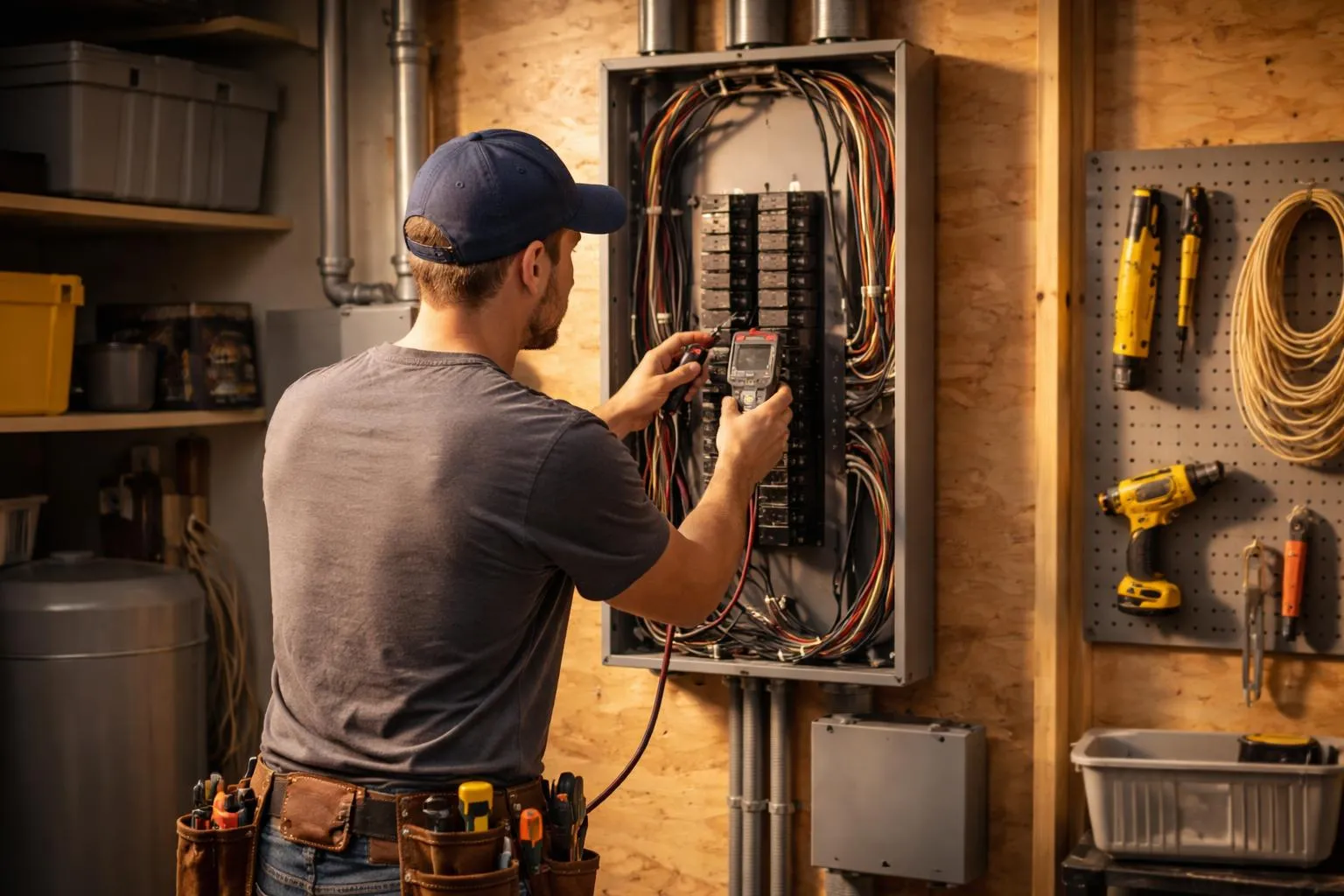
If you are planning a 100A to 200A electrical panel upgrade in Metro Vancouver, the first thing you probably want is a realistic number. Fair enough. Most homeowners are not trying to become panel experts. They just want to know what this job usually costs, what drives the price up, and how long they might be without power.
The short version is this: a straightforward 100A to 200A residential panel upgrade often lands between $3,500 and $5,000 installed. Once the job needs a new meter base, a relocated service, a mast replacement, or a bigger service size, the price can climb fast.
That does not mean every higher quote is inflated. Sometimes the extra cost is real and visible in the scope. Other times, the quote is vague and missing work that will show up later as change orders. Knowing the difference matters.
Here are the common installed price bands for residential service upgrades in Metro Vancouver:
Project scopeTypical installed priceTypical on-site work timeStraight 100A to 200A panel swap$3,500 to $5,0001 day200A upgrade with new meter base$5,000 to $6,5001 to 2 days200A upgrade with service relocation$6,500 to $9,0002 to 3 days400A residential service$9,000 to $15,0002 to 4 days
These are turnkey style numbers. In other words, they commonly include permit fees, inspection, and BC Hydro coordination unless the quote says otherwise.
That last part is worth reading twice. Some estimates look cheaper because they leave out the permit, the utility coordination, or the meter base work. The base number feels nice until you are halfway through the project.
A proper quote for a residential electrical panel upgrade is not just a metal box on the wall. It usually covers a package of work that has to meet code, utility requirements, and inspection standards.
A typical 200A upgrade price often includes:
That paperwork part sounds boring, and it is, but it matters. If the permit is not closed properly, you can run into problems later with insurance questions, sale documents, or future electrical work.
I think this is where many homeowners get tripped up. They compare panels the way they compare appliances. Same amps, same job, same price, right? Not really. A lot of the cost is in labor, code compliance, utility coordination, and dealing with whatever is already there.
Two houses can both need a “panel upgrade” and still have very different scopes.
The cheapest jobs are usually straight swaps. That means the service location stays where it is, the meter setup is already close to current requirements, access is decent, conductor runs are short, and the grounding system does not need much correction. Those are the clean jobs electricians like to find when they open a wall or pull a cover.
The expensive jobs are the opposite. A few common cost drivers show up again and again in Metro Vancouver homes.
If the existing meter base is outdated, damaged, undersized, or does not meet current utility requirements, replacing it can push the project into the next price band. That adds material cost and labor, and it can change the sequence of the job.
Moving the service entrance or meter location is where pricing can jump hard. This is not a cosmetic change. It can involve new conduit runs, new conductors, revised attachment points, extra patching, different clearances, and more BC Hydro coordination.
A relocation is often the difference between a one-day job and a two or three-day job.
Older homes sometimes have incomplete or non-compliant grounding. You may need new ground rods, bonding updates, or other corrective work to bring the service up to code. Homeowners rarely see this coming because most of it is not obvious until the electrician evaluates the existing installation.
If the overhead service mast or riser is damaged, undersized, or no longer acceptable, replacing it adds labor, materials, and sometimes roofing or siding work around the penetration points.
A panel in an easy-to-reach utility room is one thing. A cramped location with awkward routing, finished surfaces, or long cable runs is another. Labor costs change when the crew has to work around tight clearances or difficult access.
A 400A residential service is a different class of job. Bigger equipment, more coordination, and sometimes a more complex layout mean a much higher installed price.
Homeowners usually focus on the installation day. That makes sense because it is the day the power goes off. But the full schedule often depends more on utility coordination than on the electrician’s actual work time.
For a straightforward upgrade, the physical installation may take about eight hours. The total project timeline can still stretch out for weeks because the disconnect and reconnect have to be scheduled.
Here is the usual sequence:
A realistic lead time for BC Hydro coordination is often 2 to 4 weeks. Permit submission itself may only take a few days, but the utility schedule is usually the slower part.
This is one reason homeowners get frustrated. The actual job might only take a day, yet the calendar says three weeks. That gap is not fake padding. It is usually scheduling.
If you want a simple planning guide, this is the rough pattern most people can expect:
A straight 100A to 200A swap is often a one-day installation.
If a new meter base is part of the scope, expect one to two days of on-site work.
If the service has to be relocated, expect two to three days.
If the job is a 400A residential service, two to four days is common.
Then add the utility and inspection scheduling around that. In practice, many homeowners care less about whether the crew is there for one day or two and more about when the earliest available utility date is.
In Metro Vancouver, contractor-permitted work through Technical Safety BC is common for this kind of upgrade. That is generally the normal route for a service change.
The permit should be pulled in the contractor’s name. The inspection has to be completed and the permit has to be closed before BC Hydro will reconnect the service.
That closed permit is not just paperwork for a drawer. Keep it. It can matter for:
If a quote seems cheaper because it leaves permitting “to owner” or treats inspection as an extra, slow down and read carefully. Sometimes there is a valid reason for line-item pricing. Sometimes it is just a way to make the top-line number look lower.
Electrical quotes are not always written in plain language. Some are clear. Some read like a puzzle.
When comparing estimates for an electrical panel upgrade, I would look for answers to five plain questions:
Check whether the quote includes permit fees, inspection, BC Hydro coordination, disconnect and reconnect scheduling, and final documentation. If those are missing, the number may not reflect the full job.
Some homes need one, some do not. If the quote is silent on meter base work, ask directly.
A good quote should say whether grounding and bonding updates are included, allowed for, or billed only if needed.
If the service entrance or meter location has to move, that should appear clearly in the scope. This is too expensive to leave vague.
The answer should include a closed permit record and confirmation that inspection was completed.
A quote does not need to be long to be good. It just needs to be specific.
Pricing is the main point of this guide, but it helps to understand why these upgrades are so common.
Many older homes were built around electrical loads that look small by current standards. A 100A service may still be enough for some households, but the margin gets tight once you add modern loads like EV charging, heat pumps, air conditioning, hot tubs, secondary suites, induction ranges, or workshop equipment.
Some people upgrade because the panel is full. Some because insurance is pushing replacement of an old panel. Some because a renovation triggers a bigger load calculation. And some because they are tired of planning their life around what can run at the same time.
A 200A service is not automatically necessary for every home. But once you start electrifying heating, transportation, or major appliances, it becomes a very common answer.
This question comes up a lot, usually right after someone sees the price.
In theory, homeowners sometimes explore permit options for their own property. In practice, a service upgrade of this type is usually contractor-led work. There is utility coordination, inspection sequencing, service equipment requirements, and safety risk that go well beyond swapping a breaker.
This is one of those jobs where the consequences of getting it wrong are serious. Power service equipment is not forgiving.
Even if a homeowner is handy, a 100A to 200A service change is generally the sort of work people hand to licensed electricians.
Metro Vancouver is not one uniform jobsite. A house in Vancouver can present very different conditions than a house in Surrey, Burnaby, Richmond, Coquitlam, or the Tri-Cities.
Permit handling is one variable. Access is another. Detached homes, laneway layouts, older service equipment, heritage-style constraints, and unusual lot conditions can all affect labor and inspection complexity.
That does not mean the published price bands are useless. They are still helpful. It just means they are a starting point, not a promise.
If one contractor says your job is a straight swap and another says it needs a meter base replacement and grounding corrections, the difference may come down to how closely each one inspected the existing setup.
If you own a typical single-family home and you are planning a basic 100A to 200A upgrade, budgeting around $4,000 to $5,500 is often a reasonable starting point.
If the meter base is older or likely to need replacement, budget more like $5,500 to $6,500.
If you already know the service location has to move, or you have overhead service issues, difficult access, or suspected mast work, a safer planning number is $7,000 and up.
For 400A residential service work, the spread is wider. Those projects can vary a lot based on layout and service configuration, so the $9,000 to $15,000 range is broad for a reason.
I would rather see a homeowner budget a bit high and breathe easier than budget to the lowest advertised number and get hit with three surprise line items.
A 100A to 200A panel upgrade in Metro Vancouver usually falls into a few clear price bands. Straight swaps often land around $3,500 to $5,000. New meter base work pushes many jobs into the $5,000 to $6,500 range. Service relocation often moves the project into the $6,500 to $9,000 range, and 400A service is commonly much higher.
The actual installation may be fast. The scheduling around it often is not. BC Hydro coordination and inspection timing can add weeks to the full process, even when the job itself only takes a day or two.
If you are comparing quotes, the smartest question is not “Who is cheapest?” It is “What is really included?” Once you know that, the numbers usually make a lot more sense.