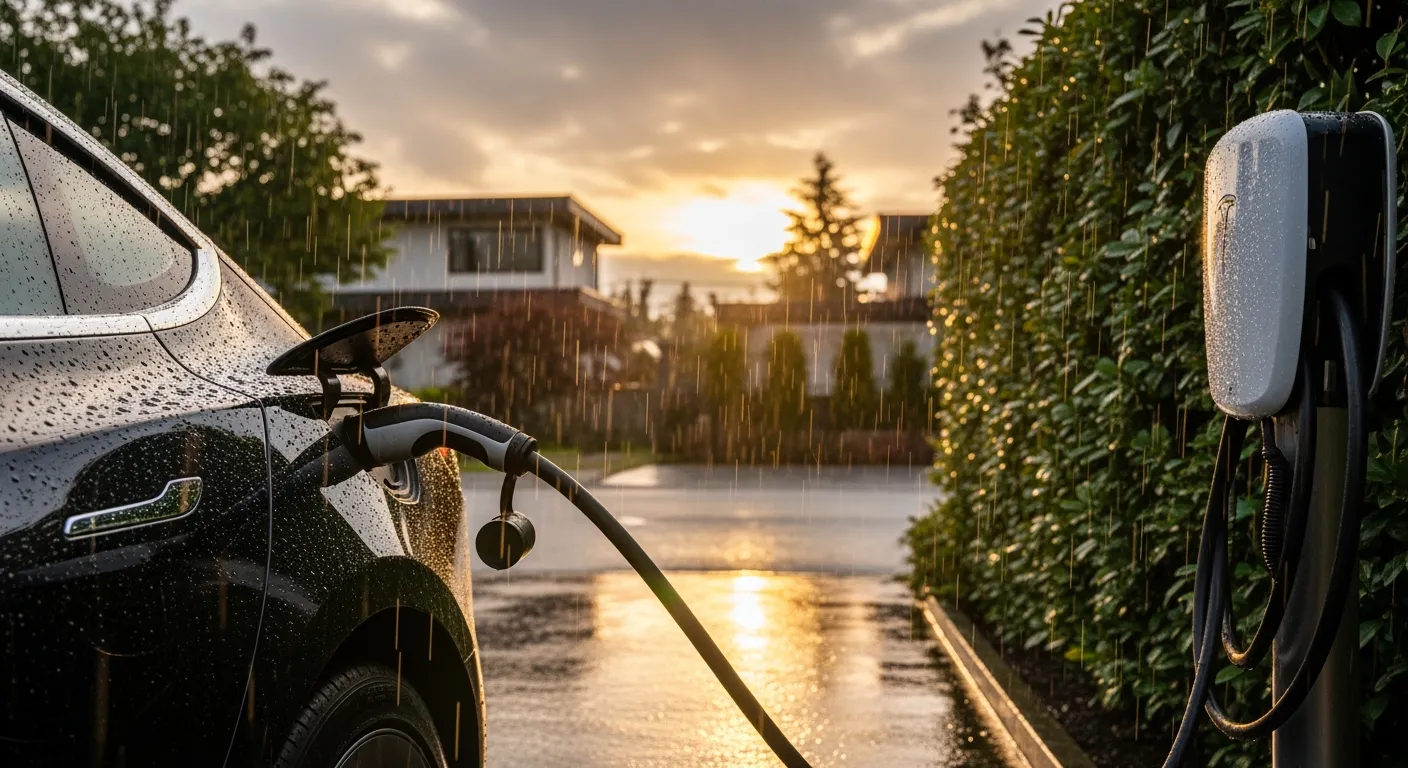
Buying an EV often feels simpler than charging it at home. The car is exciting. The charger is a spreadsheet problem.
If you live in Vancouver or elsewhere in the Lower Mainland, the question usually comes down to this: can you live with a standard 120-volt outlet, or should you install a 240-volt Level 2 charger?
For some households, Level 1 is perfectly fine. For others, it gets old fast. The right choice depends less on the car itself and more on your driving habits, your home’s electrical setup, and how much patience you have at the end of a busy day.
Here’s the practical version.
Level 1 charging uses a regular 120V household outlet. It’s the most basic way to charge an EV, and in many cases it requires no new equipment beyond the portable charging cable that comes with the vehicle.
Level 2 charging uses a 240V circuit, similar to what powers an electric dryer or range. It requires dedicated wiring and, in many homes, installation by a licensed electrician.
The difference in real life is speed.
A Level 1 charger can take well over 20 hours to fully charge a battery-electric vehicle from low to full. For some larger-battery EVs, it can take even longer. A Level 2 home charger usually cuts that down to about 4 to 8 hours, depending on the vehicle, the charger’s amperage, and how depleted the battery is.
That’s a huge gap. But full-charge time is only part of the story, because most people don’t drive from 0 percent to 100 percent every day.
This is the part that tends to change people’s minds.
Most home charging is really about replacing what you used that day, not filling the whole battery. If you drove to work, ran errands, picked up groceries, and came home having used a modest amount of range, you may only need a short top-up.
With Level 2 charging, many drivers can replace their normal daily usage in around 45 minutes to an hour. That depends on the car and the distance driven, of course, but it is a fair rule of thumb for a lot of households.
Let’s put numbers on it.
If your EV uses roughly 17 to 20 kWh per 100 km, and you drove 35 to 50 km that day, you probably used around 6 to 10 kWh. A Level 2 charger delivering around 7 kW can replace that fairly quickly. Suddenly “charging” stops feeling like an overnight project and starts feeling more like something that happens while you eat dinner.
Level 1 is different. That same amount of energy may take several hours to recover. If you drive lightly and plug in every night, that can still work. If you miss a night or have two busier driving days in a row, you can start falling behind.
That’s really the heart of the decision: do you need charging that catches up fast, or are you fine with slow and steady?
I think Level 1 gets dismissed too quickly. It’s slow, yes. But slow is not the same as useless.
Level 1 can be a good fit if most of these sound like you:
You drive short distances most days.
Your car sits parked for long stretches, especially overnight.
You have a plug-in hybrid with a smaller battery.
You want the lowest upfront cost.
You’re not ready to change your home’s electrical setup.
If you drive 20 to 40 km a day and you can plug in every night for 10 to 12 hours, Level 1 may keep up just fine. It’s also common for plug-in hybrids to work well on Level 1 because their batteries are much smaller than full EVs.
There’s also a simplicity argument. No new charger to buy. No installation appointment. No questions about panel capacity or circuit routing. You just plug into a proper outlet and go.
That said, there are two catches people underestimate.
First, Level 1 needs consistency. Miss a couple of charging windows, and recovery is slow.
Second, the outlet matters. This is not a great place for old, loose, heavily used receptacles, cheap extension cords, or shared circuits with other high-draw devices. If you’re relying on Level 1 long term, you want that outlet to be in good condition and ideally on a dedicated circuit. If you’re unsure, this is a smart time to have a residential electrical professional check it.
Level 2 starts to make a lot of sense when home charging needs to be convenient, not merely possible.
You should seriously consider upgrading if any of these sound familiar:
You drive more than about 50 to 60 km most days
You have more than one EV now, or may soon
You can’t count on plugging in for long overnight windows
You want faster recovery after road trips or busy weekends
You prefer charging flexibility over careful planning
For a lot of Vancouver households, Level 2 is less about necessity in the strict sense and more about friction. People can survive on Level 1. They just get tired of thinking about it.
If you come home late, leave early, and use your vehicle daily, a faster charger gives you breathing room. If your power comes back after an outage or you had a full weekend of driving, Level 2 helps you catch up without turning charging into homework.
There’s also a future-proofing point here. EV batteries are not getting smaller. If your next vehicle has a bigger pack than your current one, Level 1 may feel fine today and annoying two years from now.
This decision is not only about the car. In Greater Vancouver, the home itself often decides how easy a Level 2 upgrade will be.
A lot of homes in Vancouver were built long before anyone thought about overnight EV charging. Some still have 100-amp service, older panels, or limited room for new breakers. That doesn’t automatically mean you can’t install Level 2, but it does mean you may need a proper load calculation first.
Sometimes the answer is easy: there’s enough spare capacity, and a dedicated 240V circuit can be added without much drama.
Sometimes it’s not. If your panel is already handling electric heat, air conditioning, a hot tub, or other high-demand loads, an EV charger may push things close to the limit. In those cases, a load management solution or an electrical panel upgrade might be needed.
That’s where good electrical services matter. The charger itself is the simple part. The hard part is making sure the home can support it safely.
Detached homes usually have the clearest path. If you own the garage or driveway space and your panel is accessible, a Level 2 charger is often straightforward.
Townhomes can be more mixed. Shared walls, parking layouts, and panel locations sometimes make wiring more complicated.
Condos are their own category. Even if the answer is “yes,” there may be strata approval, common-property rules, meter questions, and building infrastructure issues to work through. In that case, the charging decision isn’t only about Level 1 versus Level 2. It’s about what the building will allow.
This is Vancouver. Outdoor electrical equipment lives in the rain.
That doesn’t make home charging a problem, but it does mean the equipment should be rated for the location and installed properly. Weather protection, mounting height, cable management, and circuit protection all matter more when the charger is outside or in a carport rather than inside a dry garage.
If you’re sticking with Level 1 outdoors, be especially careful. A standard household outlet used for regular EV charging should be in good condition, properly protected, and not part of a patchwork setup involving adapters and cords. Honestly, if your plan involves an extension cord across a walkway, stop there and rethink it.
People often ask whether Level 2 saves money on electricity. Usually, the answer is no, not by itself. You’re still paying for the energy you use. The main gain is speed and convenience.
So the real cost question is this: how much is your time and flexibility worth?
Level 1 usually wins on upfront cost. If your outlet is already suitable, you might spend little or nothing to get started.
Level 2 has a higher entry cost because you may need the charger, new wiring, a dedicated breaker, permit-related work, and sometimes panel changes. If the installation path is easy, that cost may be reasonable. If the panel is full or the charger location is far from the electrical room, it can climb.
The mistake I see people make is comparing only the hardware prices. The charger hanging on the wall is not the whole job. Wiring distance, panel space, service capacity, and permit requirements often decide the actual budget.
Still, if you plan to drive an EV for years, Level 2 can feel worth it quickly. Convenience has a way of becoming the thing you care about most after the novelty wears off.
If you want a practical answer without overthinking it, ask yourself four questions.
If your daily driving is light and predictable, Level 1 may be enough. If it’s moderate to heavy, Level 2 starts looking sensible.
Ten to twelve hours every night helps Level 1. Shorter windows make Level 2 more attractive.
If you often have back-to-back driving days, weekend trips, or multiple drivers sharing the vehicle, faster charging helps a lot.
If your panel has room and the parking spot is close by, Level 2 may be an easy decision. If the home needs major electrical work first, the math changes.
That last point matters because the best charging setup on paper is not always the best one for your house right now.
Charging equipment runs for hours at a time under continuous load. That’s why this is not the place for guesswork.
If you’re using Level 1 regularly, make sure the outlet is in good shape and suitable for the load. If it feels warm, trips breakers, or shares a circuit with other demanding devices, get it checked.
If you’re installing Level 2, have the wiring, breaker sizing, and load assessment done properly. This is everyday work for licensed electricians, and it’s worth doing right. The charger may look simple on the wall, but the safety of the system starts inside the panel.
That’s especially true in older Vancouver homes, where past renovations do not always leave clean, obvious electrical layouts behind. I’ve seen homes where the answer was easy and homes where the real project turned out to be fixing old electrical repairs first.
If you drive modest distances, charge consistently, and want to keep costs low, Level 1 may be all you need. There’s nothing wrong with starting there. A lot of people do.
If you want faster top-ups, less planning, and a setup that feels easy to live with, Level 2 is usually the better long-term choice. For many households, it turns EV charging into a background task instead of a daily calculation.
My honest take is this: Level 1 works best when your lifestyle is already forgiving. Level 2 works best when you want your charger to adapt to your life, not the other way around.
That’s the real difference. Not the voltage. Not the hardware. The amount of thinking you want to do every week.
For some people, a standard outlet is enough.
For others, the upgrade pays for itself in peace and quiet.