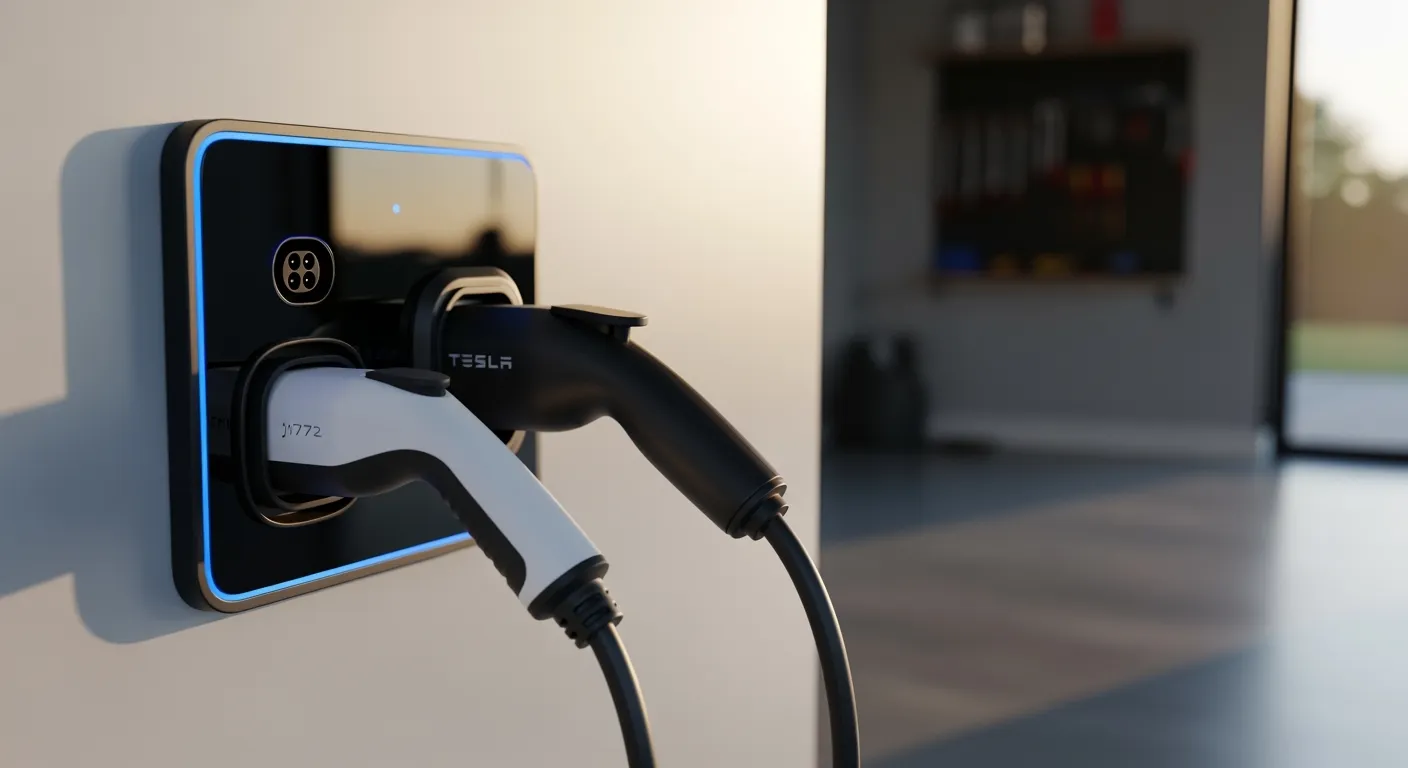
Buying an EV is the fun part. Charging it at home is where the practical questions start.
Most people begin with the same comparison: should you stick with the Level 1 charger that often comes with the vehicle, or pay for a Level 2 setup at home?
The short answer is simple. Level 1 works, but Level 2 is usually the better long term choice for homeowners who drive regularly. It is faster, easier to live with, and far less likely to leave you doing mental math about battery percentage before bed.
That said, Level 1 is not useless. For some households, it is perfectly adequate. The right answer depends on how much you drive, how often you need the car ready, and whether your home’s electrical system can support a 240 volt circuit without drama.
A Level 1 charger uses a standard 120 volt household outlet. In many cases, it is the portable charging cord that comes with the car. You plug it into a regular receptacle, plug the other end into the vehicle, and charging begins. No special equipment required, at least in theory.
A Level 2 charger uses 240 volts, the same type of power used by large household appliances such as dryers or ranges. It charges much faster, but it usually needs a dedicated circuit, proper wiring, and a professional installation.
That difference, 120 volts versus 240 volts, is what drives the whole conversation.
Level 1 is convenient because it is easy to start with. Level 2 is convenient because it makes daily life easier after that.
Those are not the same kind of convenience.
Here is the quick version.
FeatureLevel 1 ChargerLevel 2 ChargerCharge speedAbout 3 to 5 miles of range per hourAbout 15 to 40 or more miles of range per hourTypical power outputAround 1.4 to 1.9 kWOften 3.8 to 11.5 kW at homeEquipment costOften included with the vehicleCharger usually purchased separatelyInstallation costUsually none if outlet is safe and suitableModerate to high, depending on wiring and panel capacityInstall requirementsStandard 120V outletDedicated 240V circuit, proper breaker, and often permit or inspectionBest forVery light driving, backup charging, temporary setupsDaily charging, multiple drivers, faster overnight charging
The table makes Level 2 look like the obvious winner, and for many homes it is. But the details matter.
This is the part people care about most, and for good reason.
A Level 1 charger is slow. There is no polite way to say it. If you plug in overnight for 10 to 12 hours, you may recover roughly 30 to 60 miles of range, depending on the vehicle and conditions. For some drivers, that is enough. For others, it barely covers a commute.
A Level 2 charger can add several times that amount in the same overnight window. Many home setups can fully recharge a daily driven EV while you sleep. That changes the experience of ownership quite a bit.
Instead of thinking, “Can I get enough charge by morning?” you start thinking, “I never really need to stop at a public charger unless I’m on a trip.”
That shift matters more than people expect.
Cold weather matters too. Batteries charge less efficiently in low temperatures, and winter driving can reduce range. In a place like Greater Vancouver or the Fraser Valley, winters are not extreme compared with some parts of Canada, but colder months still affect charging and driving. A Level 2 charger gives you more room for that inefficiency.
I do not think Level 1 deserves the reputation of being pointless. It has a place.
Level 1 can work well if most of these are true:
A retiree with a short weekly errand routine may be completely fine on Level 1. Someone who works from home and drives 20 to 30 kilometres a day may also find it workable. It can also be useful as a temporary setup while deciding whether to invest in a permanent charger.
There is one warning here. A normal outlet is not automatically a good EV charging outlet. Long charging sessions create heat, especially if the receptacle is old, worn, or shared with other loads. If you plan to use Level 1 regularly, it is worth having an electrician check the outlet, breaker, and wiring. That is basic safety, not overkill.
Level 2 is the practical choice for most households because it solves the two problems that make people second guess home charging: time and predictability.
If you come home with a low battery, Level 2 gives you a realistic shot at waking up to a full or near full charge. If you have two EVs in the household, or one EV and a schedule that changes all the time, Level 2 gives you flexibility that Level 1 simply cannot.
It also helps if you:
This last point gets overlooked. Newer EVs often have larger battery packs than older models. A setup that feels “good enough” now can feel annoyingly slow a few years later.
There is also the issue of human behavior. People are busy. You forget to plug in. Plans change. You come home late. Level 2 is forgiving. Level 1 is much less forgiving.
That is why a professional Level 2 installation is usually the sensible recommendation for homeowners who plan to keep an EV for the long haul.
A proper Level 2 install is more than hanging a charger on the wall.
In many homes, the electrician will look at your electrical panel first. The question is whether the panel has enough capacity for a new 240 volt circuit. If it does, the job may be fairly straightforward. If it does not, you may need load calculations, a new breaker space, or even an electrical panel upgrade.
This is where residential electrical work becomes a little less simple than the internet often makes it sound.
A typical installation may include:
Hardwired chargers are often the better choice for many homes. They remove one possible failure point, reduce wear on outlets, and can support higher amperage depending on the model and code requirements. Plug in chargers can still be a good option, especially if you want the flexibility to replace the unit easily later.
If you want a clearer picture of what the process looks like, this overview of home EV charger installation in Vancouver covers the basics in a practical way.
For older homes, panel capacity is often the make or break issue. A house with aging wiring, a small service, or a crowded panel may need more than a simple charger install. In those cases, an electrician may recommend broader electrical repairs or a panel upgrade before adding EV charging.
That can feel annoying at first. It is still better than discovering the problem after tripped breakers, overheating receptacles, or unreliable charging.
This is the part nobody loves, because the answer is “it depends,” and that is true for good reasons.
A Level 1 charger often costs little or nothing upfront if it came with the car. A Level 2 setup has three main cost buckets:
First, the charger itself. Home chargers vary a lot in price depending on amperage, smart features, cable length, and weather rating.
Second, the installation. If your panel is close to the parking area and has room for a new circuit, the job is usually simpler and less expensive. If the wiring run is long, the panel is full, or trenching is needed for a detached garage, costs go up.
Third, any electrical upgrades. This is where prices can jump. A panel replacement or service upgrade is not a small add on.
In broad terms, homeowners often see something like this:
The running cost of charging, meaning the electricity itself, is a separate question. Level 1 and Level 2 do not usually differ dramatically in energy cost for the same amount of charging. The real difference is speed and convenience, not a giant savings on your power bill.
It is also worth checking whether local utilities or government programs offer current rebates or incentives for EV charging equipment or electrical upgrades. These programs change often, so it is smart to verify them before buying equipment.
EV charging is one of those tasks that feels harmless because it happens quietly. No smoke, no drama, no obvious warning signs. That can make people casual about it.
They should not be.
Charging pulls sustained electrical load for hours at a time. That means the quality of the wiring, breaker, receptacle, and installation matters. A loose connection that seems fine under light use can become a heat problem under long charging sessions.
This is one reason licensed electricians matter here. They can size the circuit correctly, confirm panel capacity, inspect existing wiring, and install equipment that matches the charger’s requirements and local code.
If you are shopping for hardware, look for chargers that are certified for use in Canada and rated for the location where they will be installed. An outdoor charger should be meant for outdoor exposure. A garage install still needs to account for moisture, cable handling, and impact risk.
Smart features can be useful too, but I would rank them behind safety and electrical compatibility. Wi Fi scheduling is nice. Solid wiring is nicer.
If you are stuck between Level 1 and Level 2, ask yourself a few plain questions.
How much do you drive most days?
If your daily use is light, Level 1 may be enough. If you drive a normal commute or rely on the vehicle heavily, Level 2 probably makes more sense.
How quickly do you need charge recovery?
If you want the freedom to come home nearly empty and head out full the next morning, Level 2 is the better tool.
Is this your first and last EV, or just the first one?
Many people start with one EV and later add another or replace it with a larger battery model. A Level 2 setup is easier to grow into than out of.
Can your home support it easily?
A newer home with available panel capacity is a different story than an older house with limited service and dated wiring. This is why a site assessment matters.
Do you want a temporary answer or a durable one?
Level 1 is often a temporary answer. Level 2 is usually the durable one.
If you are comparing Level 1 vs Level 2 because you want the best home EV charger setup, the practical answer is Level 2.
Level 1 is acceptable for a small slice of drivers. It is slow, but it can be enough if your mileage is low and your schedule is forgiving.
Level 2 is what most homeowners end up wanting once the novelty wears off and normal life takes over. It charges faster, fits real routines better, and makes home charging feel easy instead of like a compromise. That is why a professional Level 2 installation is usually the smart move.
You do not need the biggest charger on the market. You do need a setup that matches your driving, your home’s electrical capacity, and the way you actually live.
That tends to matter more than any marketing claim on the box.
Here is the simple version.
Choose Level 1 if you drive very little, have plenty of time to charge, and want to start with the lowest upfront cost.
Choose Level 2 if you want home charging to be reliable, fast enough for daily life, and ready for the next few years instead of just the next few weeks.
For most households, Level 2 wins. Not because Level 1 is wrong, but because Level 2 removes friction. And once you own an EV, that is what you really pay for. Less waiting, less planning, less second guessing.