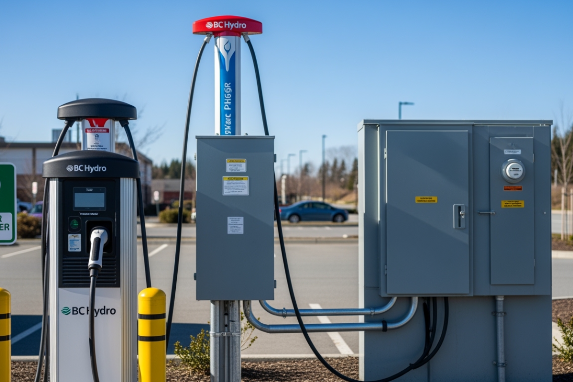
If you own or manage a commercial property in BC, you've probably heard some version of this lately: We need to be EV ready by 2026. Then the next thought lands pretty fast. What is this going to cost me?
That reaction makes sense.
Most business owners are not worried about the idea of EV charging itself. They're worried about the electrical side. Can the building handle it? Will the main service need an upgrade? Are rebates actually available? And who is going to deal with the paperwork nobody has time for?
Here’s the part I think gets lost in all the noise: the charger is often the easy part. The hard part is planning the electrical capacity, getting the pre-approval right, and making sure you don’t spend money in the wrong order.
This guide breaks down what BC businesses should know about current BC Hydro and CleanBC charger rebates, why pre-approval matters so much, and how load analysis can save you from a very expensive mistake.
On paper, EV charging sounds simple. Install a charger, apply for a rebate, move on.
Real projects are messier.
A commercial site might have aging electrical gear, limited spare capacity, shared tenant loads, or a panel that looks fine until you actually run the numbers. Add in permits, utility coordination, equipment selection, rebate forms, and parking layout, and a “small charger job” stops feeling small.
That’s why so many owners stall out at the same point. They aren’t resisting EV charging. They just don’t want to get stuck with surprise costs.
Usually, the biggest questions are these:
Those are good questions. They are also the right place to start.
People use the phrase “2026 EV mandate” to describe a broader push toward EV-ready buildings and commercial spaces in BC. Depending on your property type, renovation plans, municipality, and intended use, the requirements can show up in different ways.
For some businesses, the pressure comes from code updates or site redevelopment. For others, it comes from practical demand:
So even if your property is not being forced into a major retrofit tomorrow, the issue is already here.
And waiting until the last minute usually costs more. Not because chargers become impossible to install, but because rushed projects tend to miss rebate windows, skip planning, and end up needing reactive electrical work.
The part most owners care about first is the rebate. Fair enough.
Current BC Hydro and CleanBC programs can provide up to $2,000 per charger, depending on the program stream, the site, and the equipment being installed. Exact funding amounts, eligible expenses, and site caps can vary, so the first rule is simple: confirm the current program details before buying anything.
That last part matters more than people think.
In many cases, pre-approval is required before equipment is purchased or installation begins. If a project jumps ahead without the right approval, the rebate can disappear. That’s one of the most frustrating ways to lose money on an EV charger project, and it happens because the timeline is easy to underestimate.
Rebate programs commonly look at things like:
Some programs cover a portion of the charger and installation costs. Others put limits on how much is available per connector or per site. The headline number is helpful, but it doesn’t tell you what your project will actually look like.
That’s why a real estimate matters.
A business with spare capacity and a clean installation path may be able to add chargers at a pretty reasonable cost after rebates. A business that needs trenching, new distribution equipment, or a service upgrade is in a different category entirely.
Same charger. Very different project.
Honestly, pre-approval is where many projects bog down.
It sounds administrative, but it usually depends on technical information. The rebate application may need site details, charger specifications, load information, electrical scope, and supporting documents that the owner often doesn’t have sitting in a folder.
This is where people start feeling stuck.
They may know they want two or four chargers, but they don’t know:
And no, guessing is not a great plan here.
A pre-approval package is strongest when it comes from a proper site review, not from rough assumptions. If the electrical design changes halfway through the job because the service capacity was misread, that can affect pricing, timing, and rebate eligibility.
This is the part I wish more people asked first.
Before talking about charger brands or rebate amounts, you need to know whether the building can safely carry the added load. That means load analysis.
Load analysis is how an electrician determines whether your existing electrical service has enough capacity for EV charging without overloading the system or “blowing the main breaker,” as many owners put it.
That phrase is blunt, but it gets to the point.
A proper load analysis looks at the building’s actual electrical demand, not just the nameplate rating on the service. It considers what equipment is installed, what is running at the same time, how the site is used, and how EV chargers would fit into that pattern.
For a commercial property, that can include:
This is where projects often take a turn for the better.
Some sites that owners assume need a major service upgrade actually have enough available capacity once the load is calculated properly. Other sites look fine at first glance, then turn out to be tight because of peak demand or existing equipment.
A good electrician won’t guess. They’ll calculate.
And if the numbers are close, there may be options besides a full upgrade. Load management systems, scheduled charging, or phased installation can sometimes let you add chargers without immediately upsizing the service.
That can be the difference between a manageable project and a budget problem.
This is the part clients usually appreciate most: not the charger itself, but the process around it.
West Trust Electric handles the pre-approval paperwork and the electrical planning that many owners find tedious or confusing. That includes the load analysis needed to show whether chargers can be added safely under the existing service.
A typical process looks like this.
First, the property is assessed in person. That means looking at the electrical room, panels, available service capacity, parking layout, and the best route for wiring.
For commercial electrical projects, the physical layout matters more than people expect. A charger installed 15 feet from the panel is one job. A charger that requires long conduit runs, coring, trenching, or tenant coordination is another.
This is where the project gets real.
West Trust Electric reviews the building load to determine whether the current service can support the proposed chargers. If it can, great. If it can’t, the next step is not automatically “buy a bigger panel.” Sometimes there are smarter options, like managed charging or staging the installation in phases.
This is also the step that gives owners clarity. Instead of vague reassurance, they get numbers.
Once the capacity is understood, the charger type and location can be matched to the actual use case.
A customer parking area has different needs than a staff lot. A fleet yard has different needs than a small office building. In light industrial or industrial electrical settings, charging strategy matters even more because the rest of the facility may already have heavy loads.
This is the pain point a lot of clients want off their plate.
West Trust Electric helps assemble the information needed for pre-approval, including project scope, charger details, pricing, and the technical support documents tied to the installation plan. That reduces the chance of missing something that could delay or derail the rebate.
After approval, the installation moves ahead through the normal electrical process: permits, wiring, mounting, protection devices, testing, and final commissioning.
Because the project was planned properly up front, there is less chance of ugly surprises in the middle.
Once the job is complete, the remaining paperwork can be submitted to support the rebate claim and close out the project cleanly.
That sounds boring. It is a little boring. But it’s also where money gets recovered.
Here’s what this looks like in practice.
This is often the simplest case. The owner wants a couple of Level 2 chargers for staff or customer use.
If the building has spare capacity and the chargers are located near existing electrical infrastructure, the project can stay fairly contained. The rebate may cover a meaningful part of the installation cost, especially if no panel upgrade is needed.
The main risk here is underestimating the electrical path. A short-looking run on a site plan can turn into a more involved install once walls, finishes, and parking layout are factored in.
This gets more complicated fast.
Who is paying for the electricity? Who controls access? Is the charger a landlord amenity, a tenant-specific asset, or a shared building service? Can the common electrical service absorb the added load?
These projects benefit a lot from proper planning because the electrical decisions affect leasing, billing, and future expansion. Installing two chargers now without thinking about six more later can paint a property into a corner.
This is where load analysis becomes absolutely essential.
Industrial electrical sites may already have significant demand from equipment, compressors, heating, or process loads. Adding EV charging without understanding the demand profile can lead to nuisance trips, overloaded gear, or a much larger upgrade than expected.
But there’s good news here too. Industrial and fleet sites often have predictable usage schedules, which makes managed charging a practical option. If vehicles charge overnight or in staggered windows, the electrical design can sometimes work with the existing service better than the owner expected.
When people hear “up to $2,000 per charger,” they sometimes assume the charger is most of the bill.
Often it isn’t.
The real cost drivers may include:
That doesn’t mean the project is a bad idea. It just means the budget should be built from the electrical scope outward, not from the charger price tag inward.
A few mistakes show up again and again.
The first is buying chargers too early. People see a sale, order equipment, and assume the rest will sort itself out. Sometimes that knocks the project out of rebate eligibility.
The second is skipping the load analysis. That usually leads to one of two bad outcomes: spending money on an unnecessary upgrade or discovering late in the job that the site can’t support the chargers as planned.
The third is planning only for today. If you think you may want more chargers in two years, it can be worth sizing conduit, panel space, or infrastructure now rather than reopening everything later.
And the fourth is treating EV charging like a plug-and-play purchase. It isn’t. This is electrical infrastructure. On commercial and industrial properties, it needs the same care as any other serious electrical services project.
If you’re trying to figure out whether your property is ready, start here:
That last point matters more than it seems. A charger is easy to install once. It’s expensive to redesign twice.
BC’s EV push has a lot of business owners on edge, mostly because nobody wants a straightforward charger install to turn into a major electrical surprise.
That concern is fair.
The good news is that many sites can move ahead without a dramatic overhaul, especially when the project starts with real load analysis and proper rebate pre-approval. The rebate money can help. The paperwork still has to be done right. And the electrical capacity question has to be answered with calculations, not guesses.
If there’s one thing worth remembering, it’s this: EV readiness is less about buying a charger and more about planning the infrastructure behind it.
West Trust Electric helps with the two parts that usually cause the most friction, the pre-approval paperwork and the load analysis that shows whether your service can carry the new demand safely. For businesses trying to make sense of commercial electrical decisions around EV charging, that groundwork is what turns a fuzzy idea into a workable project.
And usually, that’s when the whole thing starts to feel a lot less overwhelming.