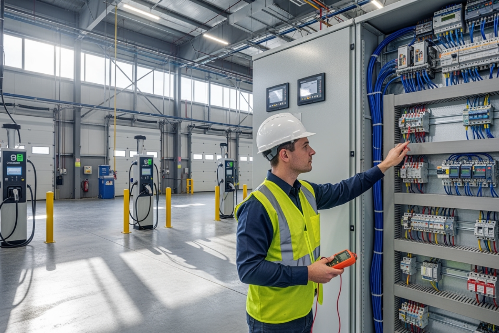
Electric delivery vans are moving from pilot project to normal business decision. In the Lower Mainland, that shift is being pushed by emissions targets, customer expectations, fuel costs, and the simple fact that more fleet-ready vans are now available.
A lot of companies start in the same place: pick the vans, pick the chargers, set an installation date.
I get why. The vehicles are visible. The chargers are visible. The electrical service is not. It sits in a utility room, does its job quietly, and gets ignored until someone asks it to power five or ten vans at once.
That is usually the real problem.
If you run an industrial yard, warehouse, service depot, or mixed commercial site, the first question is not “Which charger should we buy?” It is “Can this building safely handle the load?” In many older properties around Vancouver, Burnaby, Richmond, Surrey, and the rest of the Lower Mainland, the honest answer is no, not without planning and often not without an electrical panel upgrade, a transformer upgrade, or both.
Charging one electric van overnight may not sound dramatic. Charging a fleet is different.
A single Level 2 charger for a commercial van might draw roughly 7.2 kW, 11.5 kW, or 19.2 kW, depending on the equipment and vehicle. Multiply that by several parking spots and the numbers jump fast.
Here is the kind of math that catches people off guard:
Now add the building’s existing load: lighting, HVAC, office plug loads, compressors, shop tools, battery charging for other equipment, refrigeration, or a backup generator transfer system. That total can push an older service well past what it was designed to carry.
And that is before anyone talks about expansion. Fleets rarely stop at five vans.
This is why industrial electrical services for EV fleets are less about the charger itself and more about capacity, distribution, and timing. The charger is the end of the chain. The service entrance, switchgear, panels, transformers, feeders, and protection all have to support it.
A common assumption is that if the panel has empty breaker spaces, the site has room for chargers.
Unfortunately, empty spaces do not equal available power.
Many industrial and commercial buildings in the Lower Mainland were built for a different load profile. They were not designed around a yard full of vehicles drawing power at the same time every night. Some sites have already changed use over the years too. A warehouse becomes a light manufacturing space. An office gets added. HVAC gets upgraded. New equipment appears. The original service stays the same.
By the time EV charging enters the picture, the electrical system may already be closer to its practical limit than anyone realizes.
A few things show up again and again on older sites:
An older 200A or 400A service may have been enough for the original building use. It may not be enough once fleet charging is added, especially if the site also has heavy daytime operations.
Old panels can create two problems at once. They may not have enough capacity, and they may not be good candidates for expansion. Sometimes the issue is age, sometimes heat, sometimes code compliance, sometimes available breaker types.
This is the quiet bottleneck. A building transformer may already be carrying most of the site load. Add multiple EV chargers and the transformer becomes the weak point. Industrial transformers are not something you want to discover as a problem after chargers are already on order.
Some charging equipment works best with specific site conditions. Older buildings may have 120/208V systems where a 347/600V distribution setup would be more practical for certain loads, or the reverse. That can affect charger choice, installation cost, and overall efficiency.
Even if the main service is acceptable, the path from the service to the charging area may not be. Long runs, limited conduit space, undersized feeders, or awkward yard layouts can complicate the job fast.
This is the part people tend to underestimate. Fleet charging is not only about where the vehicles park. It is about when they return, how fast they need to be ready, and whether all of them begin charging at once.
A service company with predictable overnight parking has one profile. A courier fleet with staggered returns has another. A refrigeration contractor with early morning dispatch needs a different charging strategy than a municipal maintenance yard.
That matters because the site’s electrical service has to support the actual operating pattern, not the ideal one on paper.
Let’s say your vans return between 5:00 p.m. and 7:00 p.m. The office is still occupied. Yard lighting is coming on. HVAC may still be active. If all chargers begin at full power immediately, your peak demand can spike right when the building is already busy.
That can lead to:
None of that is a charger issue by itself. It is a service and load-management issue.
Every site is different, but a proper EV fleet project often touches more than one piece of the electrical system.
Sometimes the building needs a higher-capacity service from the utility. That can involve service entrance upgrades, metering changes, or utility-side transformer work. In the Lower Mainland, that coordination can take time, which is one more reason to start with the electrical service and not the charging hardware order.
For many industrial electrical services, this is the real make-or-break item. If the transformer is undersized, old, or already heavily loaded, new charging infrastructure may require a larger unit or a different distribution arrangement.
This is not glamorous work. It is also the work that makes the rest possible.
An electrical panel upgrade may be enough on some sites. On others, the project grows into switchboard work, new feeders, load centers, and improved protection coordination. If the existing gear is outdated, replacing it during the EV transition can be smarter than trying to patch around it.
The charging area may be far from the service room. That means trenching, conduit work, cable sizing, voltage-drop calculations, and physical protection for equipment in outdoor or industrial conditions.
Sometimes the best answer is not “make everything bigger.” Sometimes it is “control the load better.” Smart charging, scheduled charging, and dynamic load management can reduce the peak draw and delay or reduce service upgrade costs. But those systems still need solid underlying electrical design.
I understand the temptation. Budgets are tight. The fleet team wants vehicles on the road. Management wants progress this quarter.
Still, installing chargers before dealing with service capacity often creates more expense, not less.
Here is why.
First, charger locations may need to change once real electrical design starts. That means rework.
Second, an undersized service may force chargers to run below their intended output. On paper, you bought ten chargers. In practice, you have ten slow ones competing for power.
Third, permit and utility timelines for service upgrades are usually longer than charger mounting. If you ignore that early, the entire fleet schedule can slip later anyway.
And fourth, temporary workarounds have a way of becoming permanent headaches. I have seen too many projects where “just get a few working now” leads to awkward distribution, crowded panels, and future expansion costs that should have been avoided.
Upgrade the backbone first. Then the charging equipment makes sense.
Picture a service company operating from an older light-industrial building in Richmond. The building has office space in front, warehouse space in back, yard lighting, and a mix of shop equipment. The plan is to add eight electric vans this year and another six next year.
The first instinct is straightforward: install eight Level 2 chargers along the side yard.
But after load calculations, the picture changes.
The existing service is already busy during winter mornings and late afternoons. The main panel has limited room. The transformer is near its comfortable operating range. The feeder path to the yard is long and awkward. If all eight chargers start together when drivers return, the site peak gets ugly.
So the smarter plan looks different:
That approach costs real money up front. I won’t pretend otherwise. But it avoids paying twice, and it gives the company a site that actually works.
Before any charger gets specified, a licensed electrician with industrial electrical experience should be looking at the whole system.
A solid assessment usually includes:
What is the building already using during peak periods? Nameplate data matters, but real operating patterns matter more.
How much spare capacity actually exists at the main service? Is the current setup suitable for planned expansion?
Is the gear in good condition, code-compliant, and practical to modify? Or is this the moment for replacement?
Can the current transformer support fleet charging without creating heat, reliability, or future-growth problems?
When do vehicles arrive? When do they leave? How much energy do they really need each night? This is where operations and electrical design need to talk to each other.
Where will chargers go? How long are cable runs? Is trenching needed? Are bollards, weather protection, or traffic controls part of the job?
This is where a good industrial electrician Vancouver businesses trust earns their keep. Not by mounting hardware fast, but by catching the expensive problems before they get poured into concrete.
A few patterns show up often enough that they are worth calling out.
This is probably the most common mistake. People choose hardware based on rebates, speed, or supplier availability before confirming the building can support it.
Overnight helps, but it does not erase electrical limits. If ten vehicles all need substantial charging in the same window, the load is still real.
Installing for today’s five vans when you know ten more are likely is false economy. The trenching, conduit, and service planning should reflect the real direction of the business.
Residential electrical and commercial electrical jobs have their own rules and rhythms. Industrial fleet charging is different again. It often involves larger loads, tougher operating conditions, utility coordination, and more serious distribution planning.
If panels are already hot, breakers are tripping, or existing loads are pushing the service hard, EV charging will expose the weakness faster. Emergency electrical repairs are the worst time to make infrastructure decisions.
You do not need to be an Industrial Electrician to spot the warning signs.
Your site likely needs a closer look if:
Even one of those does not guarantee major upgrade work. But it is enough to stop guessing.
Electric vans make sense for many fleets in the Lower Mainland. The operating case is getting stronger, the policy pressure is real, and drivers are getting used to them fast.
But the hard truth is simple: fleet electrification succeeds or fails in the electrical room long before it shows up in the parking lot.
If you are planning to charge five or ten vans at one industrial site, start with the service. Look at the panel. Look at the transformer. Look at the real building load. Then design the charging system around that reality.
That is less exciting than picking shiny new hardware. It is also the part that keeps the project safe, code-compliant, expandable, and useful.
For businesses comparing industrial electrical services or commercial electrical services for EV projects, this is the question worth asking first: can this property actually support the fleet we want, not just the chargers we want to install?
If the answer is unclear, the next step is not shopping for chargers. It is getting a proper electrical assessment from licensed electricians who understand industrial electrical, high-voltage installations, distribution equipment, and electrical panel upgrade planning.