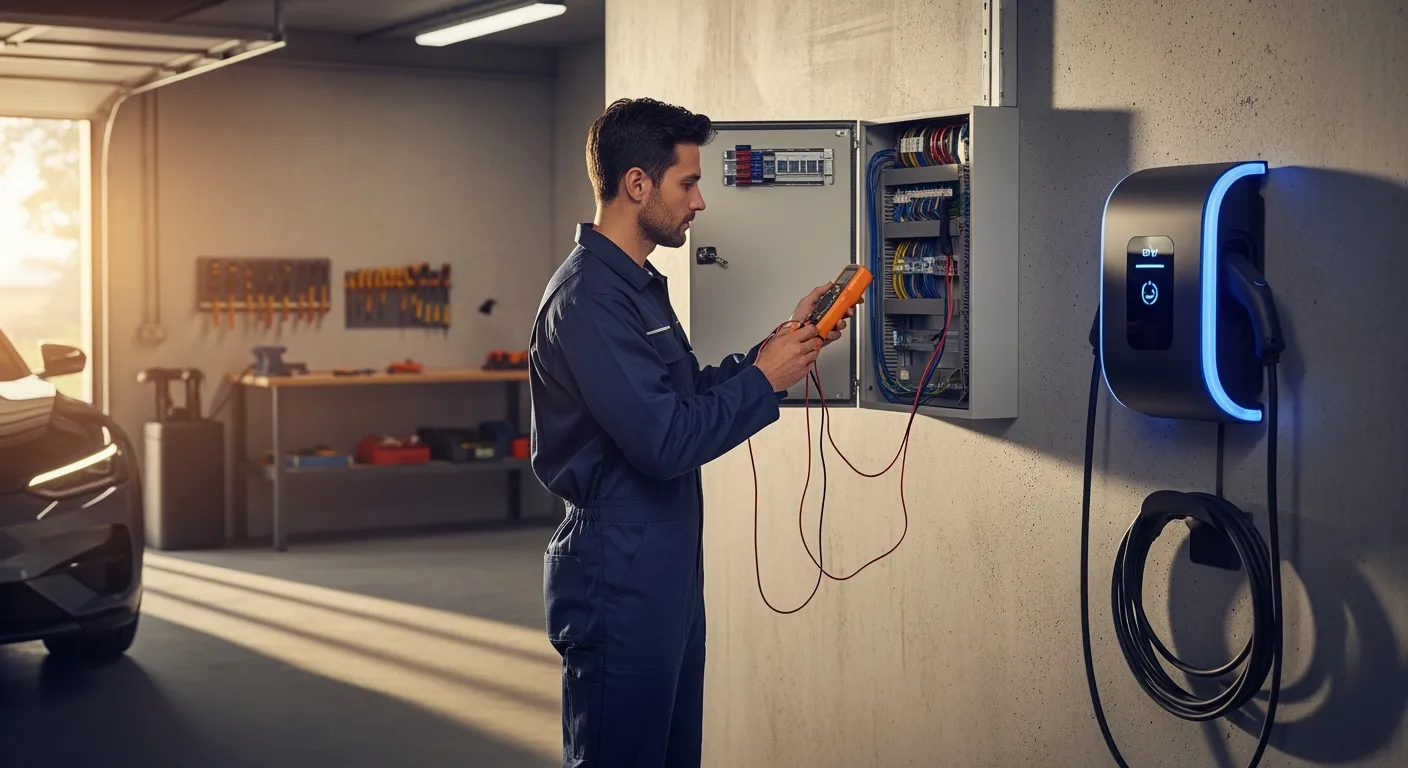
If you are planning to charge an electric vehicle at home or at a business, one question usually shows up fast: do you need an electrical panel upgrade first?
The honest answer is, sometimes. Not always.
A lot of people hear "EV charger" and assume they automatically need to jump from a 100 amp service to a 200 amp service. That is not true. Other people assume the opposite. They see a couple of open breaker spaces and figure they are good to go. That can be wrong too.
The right answer depends on your actual electrical load, the charger you want, and the condition of your current service. This is where a proper inspection matters more than guesswork.
An EV charger is not like plugging in a phone or even a typical kitchen appliance. Level 2 charging, which is what most people want for faster home or workplace charging, uses a dedicated 240 volt circuit and can draw a significant amount of power for hours at a time.
That last part matters. EV charging is treated as a continuous load, which means the circuit has to be sized with extra headroom. For example, a charger set to 40 amps usually needs a 50 amp breaker. A charger set to 48 amps usually needs a 60 amp breaker.
So the panel has to do two things:
Have physical space for the new breaker.
Have enough electrical capacity to handle that added load safely.
People often focus on the first part because it is easy to see. Open slots in the panel look reassuring. But capacity is the bigger issue. A panel can have spare breaker space and still be maxed out. It can also have no spare space, yet still have enough overall capacity if the setup is reworked properly.
"100 amp vs 200 amp EV charging" sounds simple, but real homes are messier than that.
A 100 amp service is not automatically too small for an EV charger. Some smaller homes with gas heating, gas hot water, and modest overall power use can often support a charger without a full service upgrade.
A 200 amp service is not automatically problem-free either. If a house has electric baseboard heat, central air, a hot tub, a large range, a dryer, and maybe a suite or workshop, even 200 amps can start to feel tight depending on charging needs.
I think this is the part that frustrates homeowners the most. They want a quick yes or no. The electrical system answers with, "It depends on what else is running."
A 100 amp service may be enough when the home is relatively modest and major heating loads are not electric. A few common examples:
Smaller detached homes, townhomes, or older houses with gas furnace and gas water heater
Homes without a hot tub, sauna, large workshop, or suite
EV chargers configured at a lower charging rate, such as 16, 24, or 32 amps
In those cases, a licensed electrician may be able to install a charger without a full electrical panel upgrade, especially if the load calculation comes back within safe limits.
That said, some 100 amp panels create problems even when the math looks close enough. The panel might be old, full, deteriorated, or not suitable for new equipment. If the service is already showing age, an EV project sometimes becomes the moment when people stop patching and do the upgrade they were going to need anyway.
A 200 amp service gives you more breathing room. It is often the better fit if you have a larger home, more electric appliances, or plans to add other loads soon.
A panel upgrade becomes more likely when you have:
Electric heat or heat pumps with backup electric heat
An electric range and dryer
Air conditioning
A hot tub or pool equipment
A secondary suite
A workshop with heavy tools
More than one EV now, or likely soon
This is also where future planning matters. If you are already thinking about solar, battery backup, a heat pump, or induction cooking, it can be smarter to look at the whole electrical picture now instead of making separate changes one at a time. Nobody loves paying twice for electrical work.
A proper panel assessment is more than opening the door and looking for an empty breaker slot. A good electrician reviews the system as a whole.
Here is what they usually look at:
Service size, such as 100 amp, 125 amp, or 200 amp.
Main panel condition, age, and brand.
Available breaker space.
Existing major loads, including heat, air conditioning, range, dryer, hot water, and hot tub.
The charging speed you want.
Distance from the panel to the charger location.
Whether a load calculation supports the new circuit.
Whether permits and local code requirements apply to the installation.
This is why a site visit matters. Two homes on the same street can need completely different solutions.
The label on the main breaker tells you the service rating. It does not tell you how much spare capacity you really have day to day.
A load calculation estimates how much power the building is expected to use. For a residential electrical project, that means accounting for fixed appliances, heating, cooking equipment, dryer demand, and other relevant loads under code rules. For commercial electrical or industrial electrical services, the process can get more involved because operating patterns vary more.
I see one misconception a lot: people assume their usage habits matter more than the code calculation. They might say, "We never run everything at once." Sometimes that is true. The problem is that electrical design is not based on best-case habits or promises. It is based on safe, repeatable rules.
That does not mean a service upgrade is the only answer. It just means the answer has to come from real numbers.
This point is worth slowing down for.
If your panel is full, you may still be able to add EV charging by using approved solutions such as a subpanel, tandem breakers where allowed, or rearranging circuits. But those changes only solve the space issue. They do not create more service capacity.
On the other hand, if your panel has plenty of empty spaces, that does not mean you can add a 50 amp EV circuit without concern. The service might already be carrying a heavy load from electric heat, air conditioning, and other appliances.
Think of it this way. Breaker space is about room on the shelf. Capacity is about whether the shelf can hold the weight.
If the load calculation shows your current service cannot safely support the charger you want, you still have options.
One option is a full electrical panel upgrade, often from 100 amps to 200 amps. This is the cleanest long-term solution when the home is growing electrically.
Another option is to install a charger with adjustable output. If you do not need the fastest possible charging speed, a lower-amperage setup can still work very well. Many drivers do just fine charging overnight at 24 or 32 amps.
A third option, and this is becoming more common, is load management. Some EV charging systems can monitor household demand and reduce charging power when the rest of the home is using more electricity. These systems can sometimes avoid or delay a service upgrade.
That last option is especially appealing when the panel is close to its limit but not hopelessly undersized. It can be a practical middle ground.
This is where expectations get out of hand.
Many drivers ask for the biggest charger available, then discover they do not need it. A daily commute of 30 to 60 kilometres does not usually require the highest amperage charging setup. Even a mid-range Level 2 charger can often refill that energy overnight without trouble.
Faster is nice, sure. But faster also means a larger circuit, more stress on a tight panel, and sometimes a more expensive install. If your routine gives the car eight or ten hours to charge, a moderate charging rate may be all you need.
That is why charger selection and panel planning should happen together. Picking the charger first and asking questions later can box you into a more expensive project.
Sometimes the issue is not just ampacity. It is panel condition.
If the existing panel is old, has corrosion, overheats, has known reliability issues, or shows signs of poor past wiring work, installing an EV charger may bring those problems to the surface. In that case, a panel upgrade is less about "making room for the car" and more about bringing the electrical system up to a safer standard.
This shows up often in older residential electrical systems, but it matters for commercial electrical and industrial electrician work too. A service that is technically functioning can still be a poor foundation for new equipment.
If you have flickering lights, tripping breakers, buzzing sounds, heat at the panel, or a history of electrical repairs, it is worth getting the panel checked before planning charging equipment.
For homes, the big question is usually whether existing service capacity can handle a Level 2 charger.
For commercial electrical services, the conversation gets wider. You may be thinking about employee charging, fleet vehicles, public access chargers, billing, or multiple chargers at once. A single charger might be easy. Several chargers can trigger service changes, demand management planning, and coordination with the local utility.
For industrial electrical services, the issue is even less likely to be a simple breaker swap. Sites may involve high-voltage installations, transformers, backup generator installation, distribution upgrades, or equipment that already pushes the electrical system hard. If EV charging is being added to a warehouse, plant, or yard, the charging project should be reviewed like any other substantial load.
The common thread is simple. EV charging is part of the electrical system, not separate from it.
For EV charger work, permits and inspections are often part of the process. Requirements can vary by municipality and authority having jurisdiction, so this is not something to guess at.
A licensed electrician should know what applies in your area, whether you are in Vancouver, the Lower Mainland, or elsewhere in BC. That matters for safety, insurance, resale, and peace of mind. DIY electrical work is tempting until it is time to trust it with hours of continuous charging inside or beside your building.
If you are comparing options for licensed EV charger installation in Vancouver, ask whether the assessment includes load calculations, permit handling, and panel review, not just the charger hookup itself.
There is no perfect shortcut, but some clues point in that direction.
If your home or building has a 100 amp service and several large electric appliances, the odds of needing a panel upgrade go up. The same is true if the panel is full, old, or already has a history of nuisance tripping. Wanting a high-output Level 2 charger also raises the chance.
On the business side, needing multiple chargers, planning fleet charging, or adding chargers to a site with heavy existing electrical loads often pushes the project past a simple install.
Still, none of those signs replace an actual assessment. I would not spend money based on rules of thumb alone.
Sometimes yes. Often no. Very often, the answer is "not the way you think."
You might need a full electrical panel upgrade. You might only need a lower-amperage charger. You might be able to use load management. You might need a panel cleanup, not a service replacement. Or you might have a 200 amp panel and still need a more careful design because the rest of the building uses a lot of power.
The safest approach is pretty plain: have a licensed electrician evaluate the service, perform the load calculation, inspect the panel condition, and match the charger to how you actually drive.
That beats assumptions every time.
If you are trying to sort out a panel upgrade for EV charger installation, the main takeaway is this: service size matters, but it is only part of the picture. Capacity, condition, charger output, and future electrical plans all matter too. A 100 amp service is not automatically disqualified. A 200 amp service is not automatically ready. The details decide it.