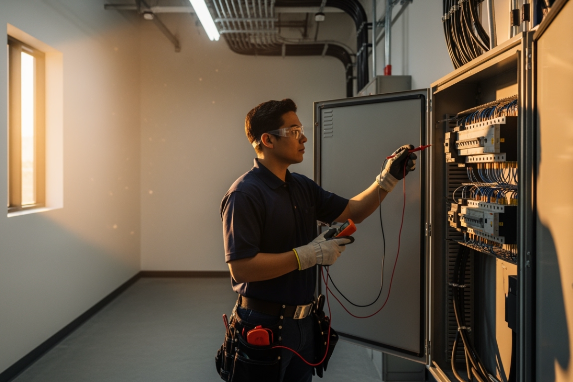
Most people don’t think much about a building’s electrical system until something stops working.
A breaker trips during business hours. Half the lights flicker. A renovation uncovers old wiring that doesn’t match the plans. Suddenly, electrical work goes from background infrastructure to the thing that decides whether your day stays on track.
That’s why commercial electrical work deserves more attention than it usually gets. It isn’t just “bigger residential electrical.” It has its own demands, its own safety risks, and its own consequences when corners get cut.
If you manage an office, retail unit, warehouse, restaurant, or mixed-use property, this matters. Good commercial electrical services do more than power a space. They help keep people safe, equipment running, and downtime under control.
People sometimes assume an electrician can move easily between residential electrical and commercial electrical with no real difference. Some skills overlap, of course. Wiring is wiring, and safety rules still rule everything. But commercial work usually involves more complexity.
A commercial building may have:
An office has different needs than a retail store. A restaurant is different again. A warehouse, clinic, school, or manufacturing site can bring a completely different set of load calculations, panel requirements, and safety concerns.
That’s the first thing worth getting straight: commercial electrical work is about planning for how a business actually uses power, not just installing enough outlets to make a room functional.
The phrase “commercial electrical services” covers a lot. If you’re hiring for a project, it helps to know what sits under that umbrella.
This starts before wires go in the walls.
Planning includes things like load calculations, circuit layout, panel sizing, lighting placement, equipment requirements, and code compliance. In a new build or renovation, this stage shapes everything that comes after it.
Bad planning tends to create expensive problems later. You see it when a panel is undersized, when lighting feels uneven, or when equipment ends up sharing circuits it never should have shared in the first place.
Good design work asks practical questions early:
That last point matters more than people think. A commercial space rarely stays frozen forever.
Construction wiring is the backbone of the system. It includes branch circuits, feeders, conduit, cable runs, disconnects, device boxes, and connections to equipment and fixtures.
This is where getting it right the first time matters most.
If the wiring is sloppy, undersized, poorly routed, or badly documented, the building may keep functioning for a while. That’s the annoying part. Problems often don’t show up immediately. They appear months later as nuisance trips, overheating, unreliable equipment, or expensive troubleshooting calls.
The electrical panel is not glamorous, but it has a big job. It distributes power safely and gives you a controlled way to isolate circuits, protect the system, and manage loads.
In commercial spaces, panel work often includes:
An electrical panel upgrade is often needed in older buildings, especially after a tenant change, expansion, or equipment upgrade. A space that once handled desks and lamps may now need to support refrigeration, commercial kitchen gear, server equipment, or EV charging.
Panels don’t care about optimism. If the load is wrong, the load is wrong.
Lighting affects more than visibility. It affects safety, productivity, comfort, and energy use.
Commercial lighting work can include:
A lot of buildings still waste money on outdated fixtures or poorly planned layouts. I’ve seen spaces with bright entryways and dim work areas, storage rooms with no motion controls, and parking lots that are either overlit or not lit enough where it counts.
Good lighting isn’t about making everything as bright as possible. It’s about putting the right light in the right place.
Tenant improvements are one of the most common reasons businesses call a commercial electrician.
When a new tenant moves in, or an existing tenant reconfigures a space, the electrical system often needs to change too. Walls move. Counters get added. Offices become treatment rooms. Open retail becomes storage and fulfillment. A simple layout change can trigger a surprising amount of rewiring.
Tenant improvement work may involve:
This work looks simple on paper. In practice, it can expose old shortcuts, undocumented changes, and capacity limits that no one noticed before.
Commercial electrical repairs are often urgent because downtime costs money.
Common calls involve:
The hard part is that symptoms don’t always point cleanly to the root cause. Flickering lights might be a fixture problem, a wiring issue, a loose connection, voltage drop, or a load problem elsewhere. Good troubleshooting saves time because it looks past the obvious first guess.
Maintenance doesn’t get much attention because it’s not exciting. Still, it’s one of the smartest things a business can budget for.
Commercial maintenance may include routine inspections, tightening connections, thermal checks, breaker testing, fixture replacement, emergency lighting checks, and catching wear before it turns into failure.
Retrofitting is common in older properties. This might mean replacing outdated lighting with LEDs, upgrading panels, improving controls, or replacing worn wiring in areas that have seen years of patchwork changes.
Retrofitting can feel expensive until you compare it to the cost of repeated failures, tenant complaints, or a shutdown.
You can hide bad electrical work for a while. You can’t hide it forever.
When panels and wiring are done poorly, the risks go beyond inconvenience.
Loose connections, overloaded circuits, damaged insulation, and wrong breaker sizing can all create heat. Heat is where a lot of electrical trouble starts.
Commercial spaces have people moving through them all day. Staff, customers, tenants, delivery drivers, maintenance teams. A system that isn’t installed correctly puts all of them at risk.
A business doesn’t need a full outage to lose money. Even short interruptions can create problems.
A retail store loses point-of-sale access. An office loses network equipment. A restaurant loses refrigeration. A warehouse loses dock productivity. Some operations can tolerate delays. Others can’t.
If uptime matters, the electrical system has to be built and maintained with that reality in mind.
A building with no spare capacity becomes expensive to adapt. Every new circuit becomes a workaround. Every equipment addition turns into a debate. Every renovation starts with “Can this panel even handle it?”
You don’t need to overbuild everything. But you do need to think past today.
Poorly executed commercial electrical work can create inspection failures, permit problems, and insurance headaches after an incident. No property owner wants to learn about undocumented wiring changes after something has already gone wrong.
Some issues show up again and again.
This usually means one of a few things: overloaded circuits, faulty breakers, equipment problems, or wiring faults. Resetting a breaker over and over is not a fix. It’s a delay.
Sometimes it’s just aging lamps or drivers. Sometimes it’s voltage drop, poor connections, or overloaded lighting circuits. In work areas, poor lighting becomes a safety issue fast.
This seems minor until extension cords start appearing everywhere. In commercial spaces, that’s usually a sign the layout changed but the electrical work never caught up.
Older buildings often have wiring that has been modified in layers over time. One tenant added something. Another removed something. Someone labeled a panel. Someone else didn’t. Eventually the system stops making sense.
If a panel is full, improperly labeled, running hot, or constantly being “worked around,” it may be time for a proper review or an electrical panel upgrade.
Good electrical work is not just installation. It’s process.
A licensed electrician working on a commercial project will usually move through several stages:
That last part sounds boring, but it isn’t. Documentation is what turns a future service call from a scavenger hunt into a straightforward job.
A lot of owners and tenants assume a commercial unit can be reworked quickly because “the power is already there.” Sometimes that’s true. Often it’s only partly true.
Tenant improvements tend to uncover things like:
This is why electrical work should be part of the conversation early in a renovation, not after walls are framed and deadlines are tight.
If I had to name one expensive mistake, it would be this: treating electrical as a late-stage adjustment instead of an early-stage design decision.
Emergency electrical repairs are sometimes unavoidable. Equipment fails. Connections loosen. Water gets where it shouldn’t. Age catches up with components.
Still, many commercial emergencies start as small issues that were easy to miss and cheaper to fix earlier.
Preventive maintenance helps catch:
A planned maintenance visit also gives you a clearer sense of what should be budgeted next. That matters for property managers and business owners who hate surprise costs, which is most of them.
Since many property owners deal with more than one type of building, it helps to know the difference.
Residential electrical work focuses on homes, condos, and small dwelling units. It often includes lighting, receptacles, electrical repairs, panel changes, renovations, EV chargers, and sometimes home automation.
Commercial electrical work deals with spaces where people work, shop, receive services, or operate businesses. It usually involves higher occupancy, more complex lighting, more demanding panel distribution, and greater pressure to avoid downtime.
Industrial electrical work is its own category. It often includes heavy equipment, motor controls, industrial transformers, high-voltage installations, backup generator installation, process systems, and more specialized safety procedures. An industrial electrician may work in factories, processing facilities, plants, and other environments where the electrical system supports production itself.
The line between commercial electrical and industrial electrical can blur in some mixed-use facilities, but the demands are not identical.
If you’re comparing contractors, ask direct questions.
You do not need the fanciest pitch. You need clear answers.
A good electrician should be able to explain the work in plain language, tell you what is urgent versus what is optional, and avoid making every issue sound catastrophic.
That last part matters. Some electrical problems are serious. Some are just messy. Knowing the difference is part of the job.
If you notice any of these in a commercial space, don’t leave them sitting for weeks:
You don’t need to panic. But you do need to investigate.
Customers notice finishes. Staff notice comfort. Owners notice bills and downtime.
The electrical system sits behind all of that, mostly out of sight, doing work that only becomes obvious when it fails. That’s why commercial electrical work should be treated like a core building system, not a box to check off near the end of a project.
Good planning, correct wiring, safe panel work, dependable lighting, and timely electrical repairs make a commercial space easier to use and easier to trust. And if you manage property for long enough, you start to appreciate something simple: the best electrical work is often the work no one has to think about twice.