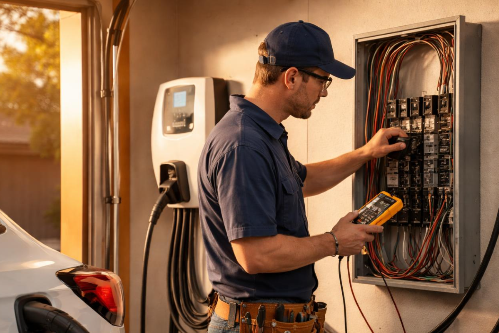
EV Charging looks simple from the driveway. Buy a charger, mount it on the wall, plug in the car, done.
Real life is messier.
A charger is only the visible part of the job. Behind it, there is wiring, breaker capacity, load calculations, permit requirements, utility rules, and sometimes an electrical panel upgrade. If the building is older, that “simple install” can turn into a bigger conversation fast.
That is why the April 2026 rebate updates matter. If you live or operate a business in the Lower Mainland or Fraser Valley, now is the time to start the paperwork, not after you have bought equipment. Rebate programs for EV Charging often come with strict conditions, and missing one step can cost you funding.
I think this is where good electrical work really shows itself. Anyone can talk about a charger. The better electrician understands both old school wiring and new school technology. That means knowing how to deal with aging panels, older service sizes, aluminum wiring, tenant spaces, industrial loads, and smart charging systems, all in the same conversation.
If you are counting on a rebate to help pay for EV Charging, timing matters almost as much as the installation itself.
Program updates often change things like:
That last point catches people off guard. A lot of applications fail for boring reasons, not technical ones. The charger works fine, but the paperwork is incomplete. Or the equipment was purchased too early. Or the invoice does not match the applicant’s legal name. It happens more than people expect.
In the Lower Mainland and Fraser Valley, demand for EV Charging keeps rising, and rebate funding does not last forever. Even when a program stays open, the rules can tighten. Starting now gives you time to confirm eligibility, review your site, and gather the right documents before money is on the line.
This is the part that gets overlooked.
A Level 2 charger adds a serious electrical load. For a house, that can mean a 240-volt circuit that draws far more power than a standard receptacle. For a business, it can mean several chargers operating at once, sometimes during peak hours. For an Industrial Electrical site, it can affect shift planning, service capacity, and demand charges.
So before anyone talks about charger brands or app features, the basic questions should be:
A lot of residential electrical and commercial electrical problems start when this step is rushed. The charger is treated like an appliance purchase when it is really an infrastructure decision.
That is especially true in older parts of the Lower Mainland, where many homes still have smaller services than modern households need. Add a heat pump, induction range, hot tub, or suite, and the margin gets thin. An EV charger may still fit, but only after a proper load calculation.
This is where experience matters.
A building can have smart devices everywhere and still be held back by wiring from another era. I have mixed feelings about how often this surprises people. On one hand, no one should have to think about their panel every day. On the other, the panel decides what the rest of the building can handle.
Homeowners often run into issues like:
In some cases, EV Charging works fine with load management instead of a full electrical panel upgrade. In other cases, the panel is simply too old, too crowded, or too unreliable. If breakers are tripping, bus bars are damaged, or the panel shows heat wear, electrical repairs come first.
Commercial Electrical Services usually involve more moving parts than a homeowner expects. A retail unit, office, warehouse, or mixed-use property may need:
The charger itself may be straightforward. The site logistics usually are not.
Industrial electrical is its own category. A site may already have large motor loads, heavy equipment, industrial transformers, backup generator installation, or utility coordination tied to production schedules. Adding EV Charging for company vehicles or fleet use can change how power is distributed across the site.
Some facilities need work upstream of the chargers, not just at the charger location. That can include service upgrades, new distribution gear, or coordination involving voltage substations and high-voltage installations. This is not basic plug-and-play work. It calls for Industrial Electrical planning, not guesswork.
For residential electrical projects, the smartest move is a site review before buying equipment.
Here is what to look at.
Do not assume your home can add a charger just because there is an empty breaker space. A load calculation matters more than visual guesswork. A licensed electrician will review the service size, existing loads, and expected charger demand.
Will the charger go in a garage, carport, driveway wall, or detached structure? The farther the charger is from the panel, the more the wiring route matters. Long runs can change material cost and installation method.
Some rebates require approved EV Charging equipment. Others prefer or require smart features such as scheduling, load sharing, or energy tracking. Buying first and checking later is the easiest way to create a paperwork problem.
A permitted installation is usually part of a clean rebate file. If a homeowner skips permits to save time, that decision can get expensive later.
If you are also considering a heat pump, suite addition, hot tub, solar, or home automation upgrades, mention that early. The best installation plan accounts for what is coming next, not just what fits today.
Commercial electrical work usually has a longer decision chain. Owners, managers, tenants, strata councils, and finance teams may all have input. That slows things down if the planning is vague.
A few priorities matter right away.
Installing two chargers today sounds reasonable, but what happens if your staff wants six next year? A good design leaves room for growth. That might mean larger conduit, spare panel capacity, or software-based load sharing.
Where will drivers park? Will the chargers be public, staff-only, or assigned to fleet vehicles? Poor placement creates conflict fast. Good placement is boring, and that is a compliment.
Some businesses want free employee charging. Others need user billing, time limits, or reporting. The right EV Charging setup depends on how the site will actually be used.
Commercial sites may need protective bollards, signage, trench covers, weather-rated equipment, and proper lighting. Charging areas should be easy to access and easy to understand.
If the applicant is a corporation, property owner, or strata, the legal entity on the invoices and permits matters. Get that wrong and the application review becomes painful.
Industrial electrician work is rarely about a single charger on a wall. It is usually about demand, uptime, and operations.
For a warehouse, manufacturing site, yard, or transport depot, the questions get more serious:
This is where industrial electrical services need to be practical. Fancy software does not fix undersized infrastructure. At the same time, a full service upgrade is not always necessary if managed charging can stagger the load.
That balance is the real job.
A site with industrial transformers, larger distribution gear, or coordination with utility equipment needs careful planning from the start. If the charger plan ignores the rest of the electrical system, the site pays for it later, usually in downtime or expensive rework.
A lot of rejected or delayed applications trace back to a short list of avoidable mistakes.
Approved equipment lists matter. A charger that works perfectly may still fail the rebate criteria.
Some programs require pre-approval. If installation begins too early, the project may be ineligible no matter how well it was done.
Permits and final inspections are often part of the required file. Keep copies.
The invoice should clearly show the installer, scope of work, equipment, address, and payment details.
The person or company applying should match the supporting documents. This sounds minor. It is not.
Funding windows, installation deadlines, and submission timelines can move quickly. April 2026 updates make that more urgent, not less.
People sometimes treat an electrical panel upgrade like a failure. I do not see it that way.
If the panel is old, overloaded, undersized, or unreliable, upgrading it can solve more than the EV Charging problem. It can improve safety, reduce nuisance trips, and prepare the property for other modern loads.
That said, not every charger install needs a new panel.
Sometimes a licensed electrician can use load management to keep the charger within the home’s available capacity. Sometimes a subpanel is enough. Sometimes minor wiring changes solve the issue. And sometimes the honest answer is that the existing system is too worn out to build on.
If you have signs like hot breakers, flickering under load, corrosion, buzzing, or repeated tripping, that is not a rebate question anymore. That is an electrical repairs question. In urgent cases, it becomes emergency electrical repairs, and an emergency electrician should look at it before any new equipment is added.
A charger install touches safety, code compliance, utility coordination, and sometimes rebate administration. So the right question is not “Who can mount this box?” It is “Who can evaluate the whole system?”
Look for licensed electricians who can handle:
In the Lower Mainland and Fraser Valley, local experience matters because building stock varies a lot. One property may have a modern 200A service and easy garage access. Another may have an old panel, lane access, limited parking, and a complicated wiring route. Same charger. Very different job.
If the April 2026 rebate updates affect your project, do not wait until you are “ready to install.” Start earlier.
A simple sequence works better:
That approach is less exciting than impulse-buying a charger online. It is also the approach that avoids rework.
EV Charging is moving quickly, but buildings do not all move at the same pace. Some properties are ready now. Others need electrical work first. That is normal.
What matters is getting an honest assessment early, especially with the April 2026 rebate updates in play. If you are a homeowner, business owner, property manager, or industrial operator in the Lower Mainland or Fraser Valley, this is a good time to start the process. The paperwork matters. The wiring matters. The service capacity matters.
And in a lot of cases, the best results come from the same mindset: respect the old school parts of the electrical system, then build the new school technology on top of them properly.